What Is Happening in the Global Economy Right Now
The present time marks a significant shift in the global economy. For some time, we have been in the wake of a global pandemic, which also brought about levels of inflation not previously seen in recent history. We are now in what I would term a phase of divergent resilience. On the one hand, the world has proven quite capable of avoiding the deep recessions that many expected a few years ago. On the other hand, we are faced with a fragmented landscape in which different regions, industries, and social groups experience very different economic realities.
In today’s world, it is no longer only Wall Street analysts or academic researchers who pay attention to such changes. In an increasingly connected world, a change in interest rates in Washington or a supply chain disruption in Southeast Asia eventually shows up at the grocery store checkout line and in the ability of a small business to secure a loan. Today’s global economy is a complex interplay of cooling prices, shifting trade alliances, and large-scale technological transitions toward artificial intelligence and green energy.
Global Environmental Report
The current environment is characterized by a high level of caution, coexisting with persistent uncertainty. Global growth stands at about 3.1 percent, which is lower than what we saw in the early 2000s but still represents a “soft landing” that seemed unlikely at the height of the inflation crisis. However, this stability remains fragile. Geopolitical tensions in the Middle East and Eastern Europe play a significant role, often increasing the cost of growth by disrupting energy markets and shipping routes.
We are also observing a shift away from the past three decades of hyper-globalization toward a model referred to as “friend-shoring.” Countries are increasingly trading with political allies rather than simply choosing the lowest-cost partners. National security and supply chain reliability are now being prioritized over pure economic efficiency.
Major Trends: Rising Prices and What It Means for Consumers’ Wallets
For the average person, the most visible economic trend is the persistence of high living costs. While peak inflation has subsided in many parts of the world, prices for essentials such as housing, healthcare, and insurance remain elevated. In many developed countries, the era of steady 2 percent inflation appears to be over.
Consumers continue to feel the cumulative effects of several years of rising prices. Even though the rate of increase is slowing, overall price levels remain significantly higher than they were five years ago. This has created a “cost-of-living squeeze,” dampening consumer confidence despite strong indicators such as low unemployment.
Monetary Policy in a Changing World
Central banks, including the U.S. Federal Reserve and the European Central Bank, have shifted from aggressive rate hikes to a more cautious and calibrated approach. After raising interest rates to levels not seen in decades to combat inflation, policymakers are now determining when and how quickly to begin lowering them.
This “higher-for-longer” rate cycle has reshaped the economic landscape. For over a decade, cheap capital fueled borrowing and aggressive investment in high-growth, low-profit technology startups. Today, the financial climate is very different. Housing markets have been affected, business expansion has become more expensive, and there is a renewed emphasis on financial discipline, along with improved returns for savers.
Global Trade and International Supply Chain Development
The global trade landscape is evolving. The traditional “just-in-time” manufacturing model is giving way to a more cautious “just-in-case” approach. Companies are diversifying their manufacturing bases to reduce over-reliance on any single country.
Countries such as Vietnam, Mexico, and India have emerged as key beneficiaries of this shift, as firms seek to relocate production closer to home markets or to politically aligned regions. While this enhances economic resilience, it also introduces additional costs that were previously minimized under more efficient global supply chains.
Energy and the Green Transition
The global energy sector reflects a dual reality. Fossil fuels remain the foundation of global industry, and their prices continue to be influenced by geopolitical factors. At the same time, there is a significant structural shift toward renewable energy.
Investment in solar, wind, and battery technologies is at an all-time high. Many countries now view the transition to green energy not only as a climate imperative but also as a matter of energy security. Expanding domestically produced renewable energy sources has become a central component of economic policy in regions such as Europe and Asia.
The Digital Age and Artificial Intelligence
One of the most transformative economic trends today is the rapid growth of artificial intelligence. Unlike previous technological shifts that primarily affected blue-collar work, this transformation is increasingly impacting white-collar professions, creative industries, and data-driven roles.
Companies are investing heavily in AI to improve efficiency and productivity. While concerns about job displacement remain, many economists believe that AI will ultimately serve as a major driver of productivity growth, particularly as populations in developed countries continue to age.
Regional Highlights: A Two-Speed World
Economic performance varies significantly across regions. The United States has shown surprising resilience, supported by strong consumer spending and a flexible labor market. In contrast, Europe continues to face slower growth due to high energy costs and a delayed manufacturing recovery.
Elsewhere, the picture is diverse. China is undergoing a complex transition from an investment-driven economy to a consumption-based one, while also addressing challenges in its real estate sector. Meanwhile, Southeast Asia and Africa are experiencing dynamic growth, driven by youthful populations and increasing digital adoption.
Key Challenges: Debt and Climate Issues
Despite areas of growth, major challenges persist. Global debt—both public and private—has reached record levels. With interest rates remaining relatively high, debt servicing is placing pressure on government budgets, reducing funds available for infrastructure, education, and social programs.
Climate change is also becoming an increasingly measurable economic factor. Disruptions in agriculture and rising disaster recovery costs highlight the growing influence of environmental issues on economic stability. Transitioning to a sustainable economy will require massive investment, which presents a significant challenge in a high-debt environment.
Opportunities for Growth
Despite these challenges, there are substantial opportunities. The “Great Diversification” of supply chains is opening access for developing countries to participate more actively in global value chains. At the same time, the green energy transition is driving the creation of new markets and industries, from electric vehicles to hydrogen fuel technologies.
There is also a renewed focus on human capital development. Increasing investment in education and skills training is preparing individuals for an economy increasingly shaped by artificial intelligence and digital innovation.
Impact on Countries Like Nigeria
For countries such as Nigeria, global trends have direct and powerful effects. As a major energy producer, Nigeria benefits from stable oil prices but remains vulnerable to geopolitical volatility. Rising global interest rates have also put pressure on the naira, as investors tend to move toward “safe-haven” currencies like the U.S. dollar during periods of uncertainty.
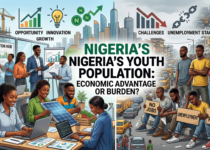
However, the global shift toward digitalization presents a significant opportunity. With one of the largest youth populations in the world and a growing base of tech-savvy individuals, Nigeria is well-positioned to export digital services and emerge as a hub for the African technology ecosystem. The key challenge lies in stabilizing the domestic macroeconomic environment to attract the investment needed to fully capitalize on these opportunities.
Future Outlook and Conclusion
Looking ahead, the global economy is likely to remain in a state of active transition for the foreseeable future. Continued volatility is expected as the world adapts to new geopolitical realities and technological advancements. The defining factors of the coming decade will include how effectively societies manage the AI revolution, how quickly they transition to sustainable energy, and whether global leaders can cooperate on trade despite political differences.
At present, the global economy demonstrates resilience, but it is also undergoing structural transformation. The acute crises of recent years have passed, but the “old normal” has not returned. Instead, a new global order is emerging—one that is more digital, more focused on security and sustainability, and inherently more complex.
For individuals and businesses alike, success in this evolving environment will depend on adaptability and a clear understanding of the global landscape.
The Future of Work in Nigeria

How to Adapt to Changes in the Job Market